There are three fair ways to split groceries with roommates: evenly, where everyone pays the same; by income, where each person pays in proportion to what they earn; and by item, where everyone covers their own food and shared staples like milk and dish soap are divided equally. Splitting evenly is the easiest to sustain. Splitting by income suits households with a real pay gap. Splitting by item is the fairest on paper and the most likely to be abandoned.
I lived with a roommate and we never split the grocery bill. Not once. He bought things, I bought things, and we both quietly assumed it evened out. I still have no idea whether it did.
I wish we had, because I am fairly confident we were buying the same staples twice. Two bottles of olive oil, two half-used bags of rice, milk going off in the back of the fridge because we had both picked one up. That is money neither of us needed to spend, and we will never know how much it was.
The reason we did not was not awkwardness. It was that itemising a receipt by hand takes about twenty minutes, and nobody keeps that up past the second week. That is the actual problem with splitting groceries, and it is worth naming before you pick a method, because it is what decides which method survives.
The three methods at a glance
| Method | Best for | Effort per shop | Survives? |
|---|---|---|---|
| Evenly | Similar diets and budgets | Seconds | Usually |
| By income | Couples, uneven earnings | Seconds, once agreed | Usually |
| By item | Very different diets | 10 to 20 minutes | Rarely |
Why most splitting systems fall apart
Almost never because the method was unfair. They fall apart because somebody has to keep the record, and keeping the record is boring. A shared note works for about a week. A spreadsheet works until the person who made it stops opening it. A group chat where you post receipt photos works until there are forty photos and nobody wants to add them up.
So the honest question is not "which method is fairest." It is "which method will we still be doing in six weeks." A slightly unfair split that everyone actually follows beats a perfectly fair one that quietly dies and leaves one person feeling like they paid for everything.
1. Split evenly
Add up the shop, divide by the number of people, done. If you spent $180 between three of you, that is $60 each regardless of who put what in the trolley.
This is what most roommates land on, and it is usually right. It takes seconds, there is nothing to track beyond the total, and it removes the running mental tally of who owes who. The unfairness is real but small: if one of you drinks the oat milk and the other does not, you are arguing over a few dollars a week.
It stops working when one person's food is genuinely more expensive. Someone buying steak and salmon while their roommate eats lentils will feel it within a month, and that is when the resentment starts rather than the conversation.
2. Split by income
Each person pays the share of the bill that matches their share of the household's take-home pay. If you bring home $3,200 and your partner brings home $2,400, that is $5,600 between you, so you cover 57% and they cover 43%. On a $200 shop that is $114 and $86.
This is the usual answer for couples, and it is worth understanding why. An even split is equal, but it is not equal in impact. The lower earner ends up with proportionally less left at the end of the month for the exact same food. Scaling the shares fixes that without anyone tracking items.
The friction here is social, not mathematical. It requires both people to say what they earn, which some households are fine with and others really are not. If that conversation is not on the table, an even split is the better answer.
3. Split by what you actually bought
Everyone pays for their own items. Shared things, the ones nobody thinks of as theirs, get divided evenly: milk, oil, salt, dish soap, bin bags, foil.
This is the fairest option and the one people ask about most, because the thing that actually annoys roommates is rarely the total. It is the sense that they are subsidising someone else's specific habit. Nobody minds paying for their own food. They mind paying for your protein powder.
The catch is the twenty minutes. Someone has to sort every line on the receipt into three piles. Do that after a long shop, in the kitchen, at 9pm, once a week, forever. That is the method that dies, and when it dies it usually reverts to an even split anyway, just with a month of bad feeling first.
Use it if your diets genuinely differ a lot. Otherwise skip to the even split and save yourself the ceremony.
Do the math right now
Rather than describing the arithmetic, here is a tool that does all three. Put in who is splitting, what they have already paid, and pick a method. It works out each person's share and, more usefully, the shortest list of payments that squares everyone up, so you get "Sam pays Alex $34.20" instead of a column of balances to interpret.
When you should not split at all
If you share finances, do not split. Families and couples with a joint account are almost always better off pooling: treat groceries as one household number, set a budget against it, and stop keeping score entirely. Splitting only earns its overhead when people keep their money separate.
If that is you, the useful question changes from "who owes what" to "is this number reasonable." The free grocery budget calculator will give you a target for your household size, and the average grocery cost calculator shows what comparable households actually spend.
How to actually bring it up
This is the part people are really searching for. The math is easy, the conversation is not, especially if you have been living together a while and never discussed it.
- Raise it as a logistics problem, not a fairness one. "We keep buying two of everything" lands very differently from "I think I'm paying more than you." The first is a shared annoyance. The second is an accusation, even when it is true.
- Propose the simplest method first. Suggest an even split before anything clever. If it turns out to be unfair, that becomes obvious within a few weeks and you can adjust with evidence instead of arguing about hypotheticals.
- Separate shared staples from personal food explicitly. Agree that milk, oil, condiments and cleaning stuff come out of a shared pot, and everything else is yours. That single distinction removes most of the friction on its own.
- Pick a settle-up day. Once a week or once a month, not "whenever." Open-ended debts are what turn into resentment, because nobody wants to be the person who brings it up.
So which one should you use?
"We eat basically the same stuff."
Split evenly. Do not overthink it. The few dollars of unfairness cost less than the effort of anything more precise.
"My partner earns half what I do."
Split by income. Same food, shares scaled to what each of you brings in. Agree the percentages once and stop revisiting them.
"One of us is vegan and one of us buys ribeye."
Split by item, with shared staples divided evenly. Accept that it takes real effort every week, and expect to drift back to an even split eventually.
"We have a joint account."
Do not split. Pool it, set one budget, and use the budget calculator to sanity check the number.
"We already owe each other and lost track."
Start from zero. Agree today's balance is settled, pick a method, and pick a settle-up day. Reconstructing four months of receipts is not worth what you will recover.
The bottom line
The best way to split groceries is whichever one you will still be doing in two months. That sounds like a cop-out, but it is the actual finding. Every household I have seen do this well picked something simple and stuck to it. Every household that failed picked something precise and quietly stopped.
One honest note about our own app, because it is the obvious next question. Groceries Tracker will not do the split for you. Receipts belong to the household rather than to whoever scanned them, so it cannot tell you that he bought the milk and you bought the chicken. That is a deliberate choice, and it means this is not a bill-splitting app.
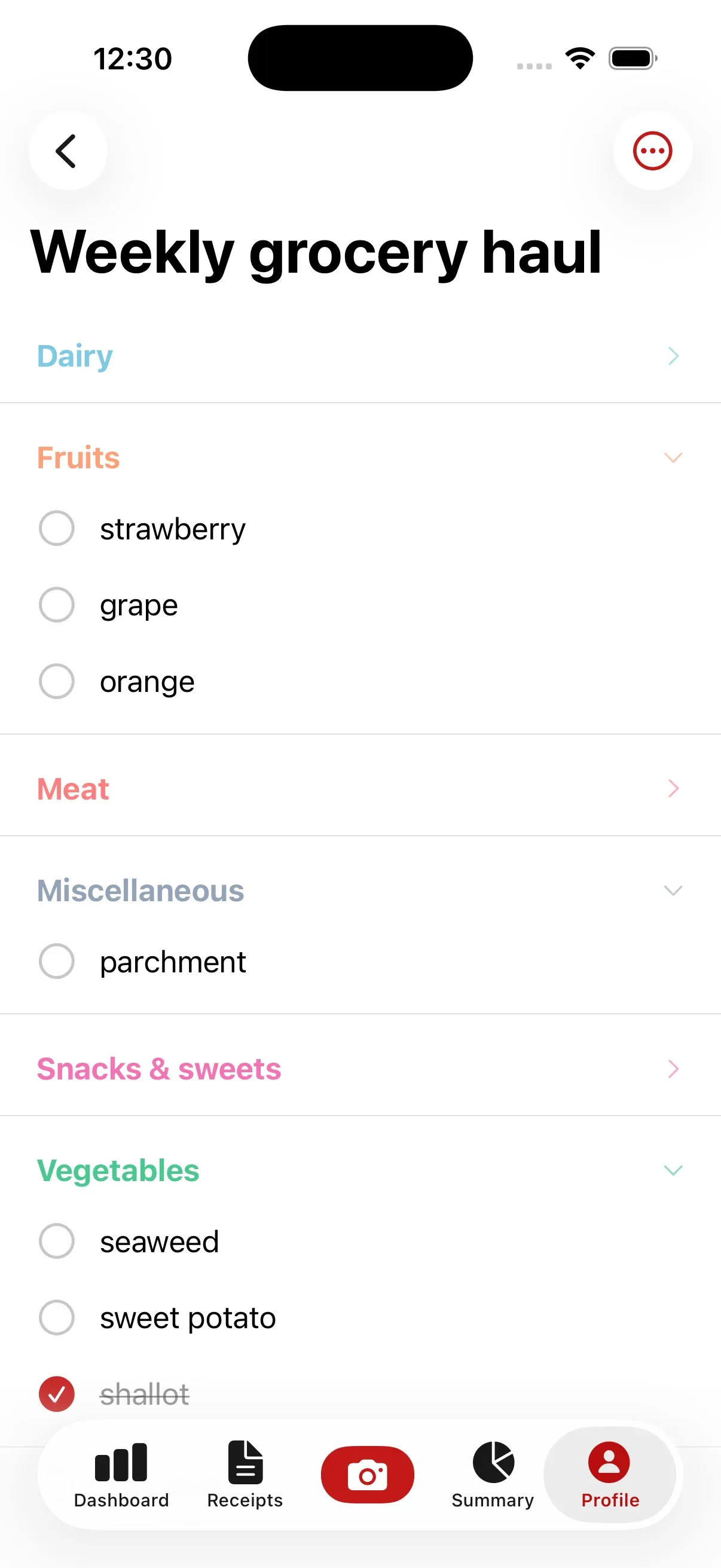
What it does is remove the part that made my roommate and me give up. You photograph the receipt, it reads every item and sorts it into categories, and the household total is just there, current, without anyone keeping a tally. Then dividing it takes ten seconds in the split calculator instead of twenty minutes at the kitchen table.
Want to stop guessing what your household actually spends? Try Groceries Tracker free, with no time limit - no credit card required.
Last updated: September 6, 2026